Aghanya Info Solution Pvt. Ltd.

Software Development

C / C++ Course

Understand how programs really work — memory, pointers and data structures — through C, then build on that foundation with object-oriented C++.

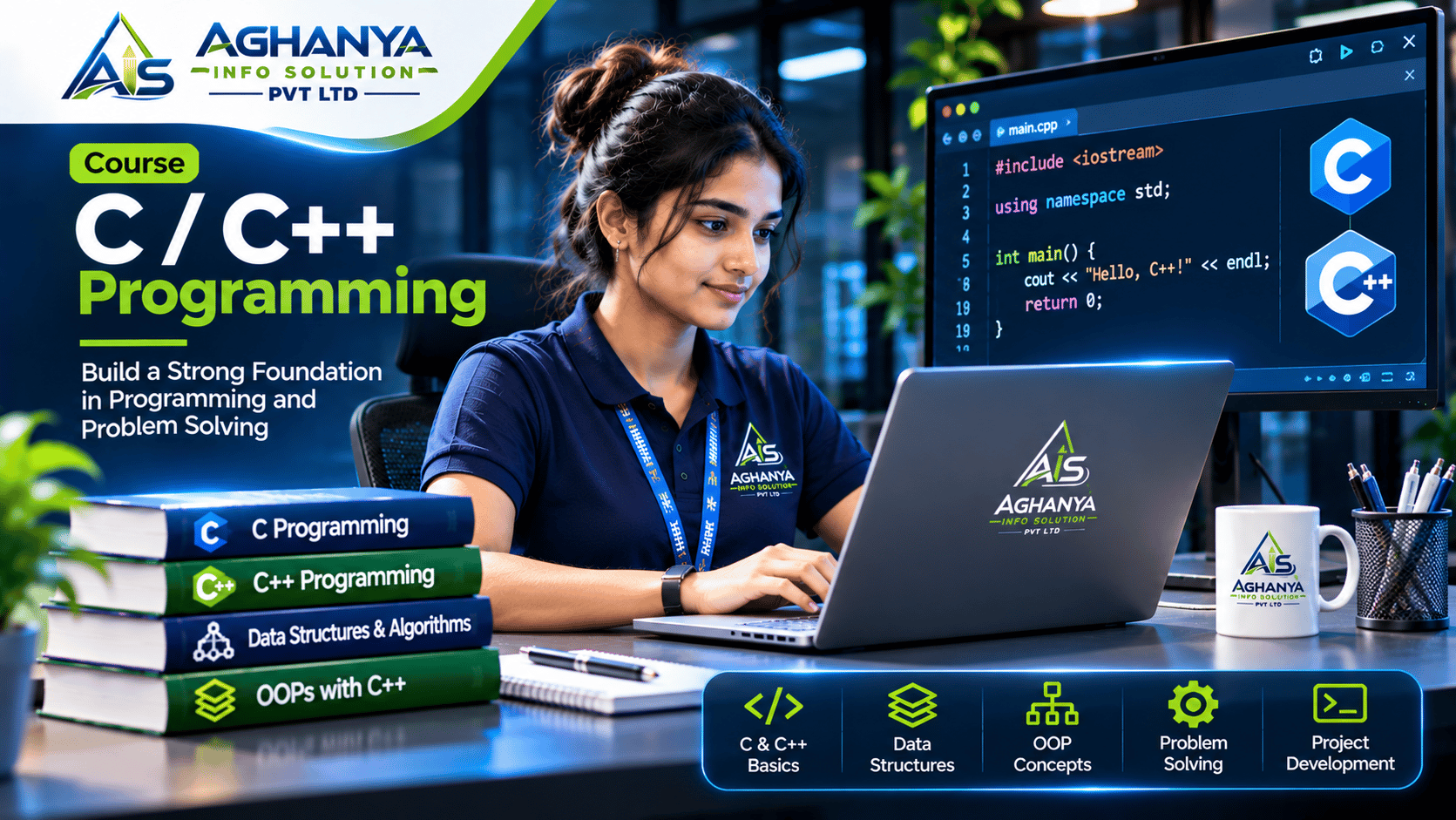
C / C++ course illustration: a learner working on C / C++

The technology

What is C / C++?

C is a compact, procedural language that gives programmers direct control over memory. C++ extends C with classes, templates and the Standard Template Library, adding higher-level abstraction without giving up performance.

Why it matters

C and C++ sit underneath operating systems, embedded devices and performance-critical software. They also feature in many technical interviews, because they reveal whether a candidate understands what code does underneath.

What you'll study

Inside the C / C++ course

C and C++ teach how programs work close to the machine and remain foundational for systems programming, embedded work and technical interviews.

This course starts with structured programming in C, covers pointers and memory management, and moves to object-oriented programming and the Standard Template Library in C++.

Learning objectives

The skills you may develop. By the end of the course you should be able to:

  • Write structured programs in C
  • Understand pointers, arrays and dynamic memory
  • Apply object-oriented programming in C++
  • Use STL containers and algorithms
  • Implement core data structures

Course modules

C / C++ syllabus outline

6 modules, each building on the last — from fundamentals to applied practice.

  1. Module 1: C fundamentals

    Learn structured programming with C's core syntax and functions.

    • Data types and operators
    • Control flow
    • Functions and recursion
  2. Module 2: Pointers and memory

    Understand memory directly — the skill that sets C and C++ apart.

    • Pointers and arrays
    • Dynamic memory allocation
    • Strings
  3. Module 3: Structures and files

    Group related data and work with files and the preprocessor.

    • Structures and unions
    • File handling
    • Preprocessor
  4. Module 4: C++ and OOP

    Move to C++ and object-oriented design.

    • Classes and objects
    • Constructors and destructors
    • Inheritance and polymorphism
  5. Module 5: Advanced C++

    Write flexible, reusable code with templates and exceptions.

    • Operator overloading
    • Templates
    • Exception handling
  6. Module 6: STL and data structures

    Use the Standard Template Library and implement classic data structures.

    • Vectors, maps and sets
    • Algorithms
    • Linked lists, stacks and queues

Tools & technologies

  • GCC / G++
  • Code::Blocks / VS Code
  • GDB

Who should consider it

  • Students building programming fundamentals
  • Engineering students preparing for technical interviews
  • Learners heading towards systems or embedded development

Before you start

Basic computer skills. No prior programming experience required.

Batch timings and fees are shared directly by our team on enquiry.

Let's Find the Right Course for You

Tell us what you want to learn and where you are starting from. Our team will help you choose the right course and share the relevant details.

Prefer a call? Request a callback

By sending, you agree to be contacted about this request.

Keep exploring

  • Software Development

    Java

    Build a dependable foundation in Java and learn to write code that other developers can read, test and extend — the habits that matter on real teams.

    Key learning areas

    • Java fundamentals
    • Object-oriented programming
    • Exceptions and I/O

    Suits: Students and graduates starting a software career

  • Software Development

    .NET

    Learn to build web applications and APIs on Microsoft's .NET platform with C# — a modern, strongly typed language known for clear code and excellent tooling.

    Key learning areas

    • .NET platform basics
    • C# language
    • Object-oriented C#

    Suits: Graduates aiming for Microsoft-stack developer roles

  • Software Development

    Python

    Start with a language prized for its readability, then put it to work on files, data and automation — writing code that stays clear as it grows.

    Key learning areas

    • Python foundations
    • Data structures
    • Functions and modules

    Suits: Beginners learning their first programming language