Aghanya Info Solution Pvt. Ltd.

Software Development

Java Course

Build a dependable foundation in Java and learn to write code that other developers can read, test and extend — the habits that matter on real teams.

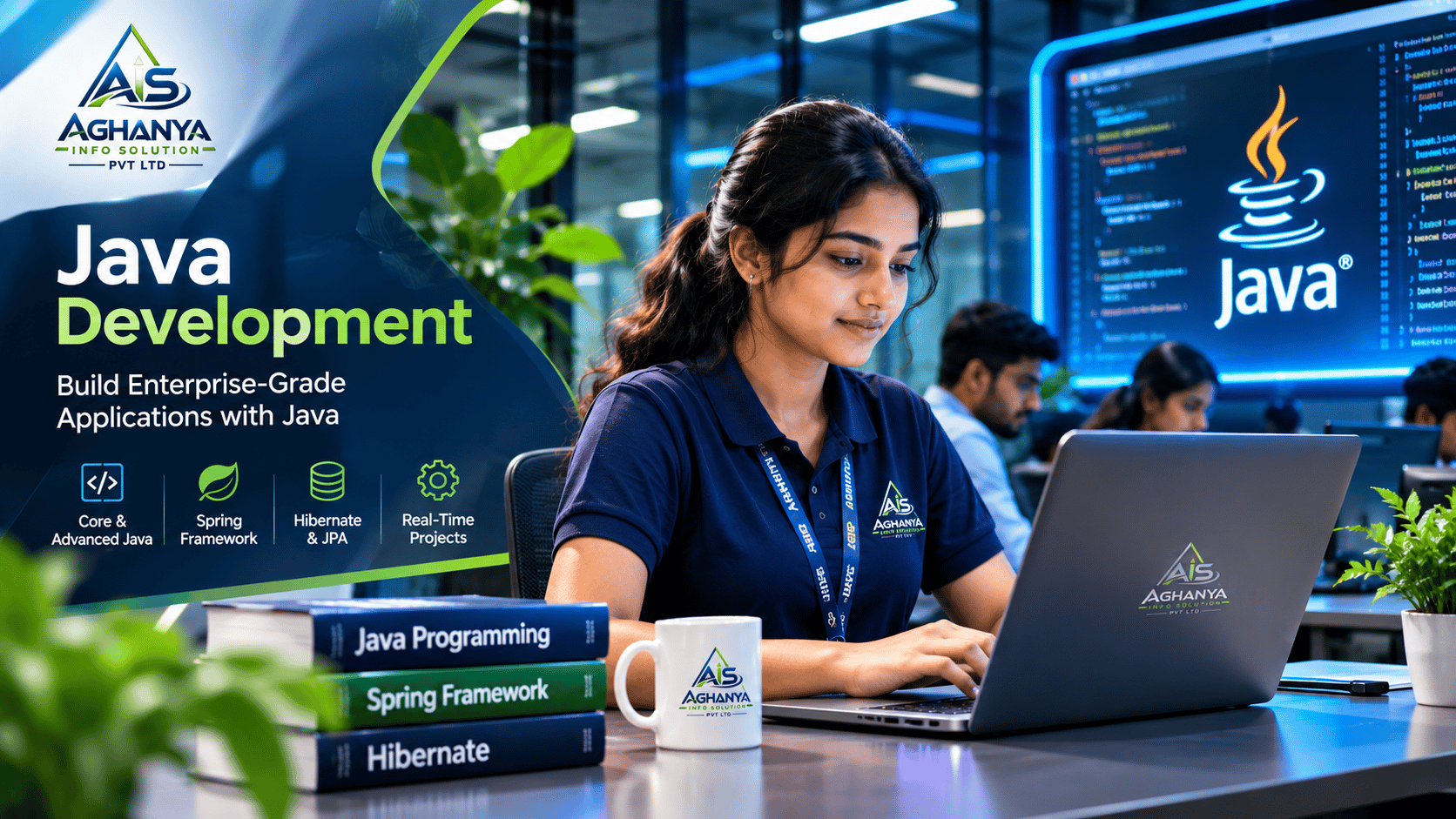
Java course illustration: a learner working on Java

The technology

What is Java?

Java is a general-purpose, object-oriented programming language that runs on the Java Virtual Machine (JVM). Code is compiled to bytecode once and runs on any system with a JVM, which is why Java appears everywhere from banking back-ends to Android apps and data tools.

Why it matters

Organisations rely on Java for systems that must stay stable for years. Strong Java skills also carry further: frameworks such as Spring, test automation with Selenium and data platforms such as Hadoop are built on Java or widely used with it.

What you'll study

Inside the Java course

Java remains one of the most widely used languages for enterprise systems, Android and backend services. This course builds a firm foundation in the language and the habits of writing clean, maintainable code.

You progress from syntax and object-oriented design to collections, exception handling, multithreading and working with databases through JDBC, finishing with an introduction to web development.

Learning objectives

The skills you may develop. By the end of the course you should be able to:

  • Write well-structured programs using object-oriented principles
  • Use the Collections Framework and generics confidently
  • Handle errors and resources safely with exceptions
  • Build concurrent programs with threads and executors
  • Connect Java applications to relational databases with JDBC
  • Understand how Java web applications are structured

Course modules

Java syllabus outline

8 modules, each building on the last — from fundamentals to applied practice.

  1. Module 1: Java fundamentals

    Set up Java and learn the building blocks every program uses.

    • JDK, JRE and JVM
    • Data types, operators and control flow
    • Arrays and strings
  2. Module 2: Object-oriented programming

    Model real things as objects — the way almost all Java code is organised.

    • Classes and objects
    • Inheritance and polymorphism
    • Abstraction and interfaces
    • Encapsulation and packages
  3. Module 3: Exceptions and I/O

    Handle errors and work with files without crashing or leaking resources.

    • Checked and unchecked exceptions
    • try-with-resources
    • File handling and streams
  4. Module 4: Collections and generics

    Store and organise data with Java's standard collection classes.

    • List, Set and Map
    • Iterators and comparators
    • Generic types and methods
  5. Module 5: Modern Java

    Write shorter, clearer code with lambdas and streams, used throughout modern Java.

    • Lambda expressions
    • Functional interfaces
    • Stream API
    • Optional
  6. Module 6: Multithreading

    Run tasks in parallel safely, as server applications must.

    • Thread lifecycle
    • Synchronisation
    • Executor framework
  7. Module 7: Database connectivity

    Read and write data in a relational database from Java code.

    • JDBC architecture
    • Prepared statements
    • Transactions
  8. Module 8: Introduction to web development

    See how Java powers web applications, and how projects are built with Maven.

    • Servlets and JSP overview
    • MVC pattern
    • Build tools: Maven

Tools & technologies

  • JDK
  • IntelliJ IDEA / Eclipse
  • Maven
  • MySQL
  • Git

Who should consider it

  • Students and graduates starting a software career
  • Developers moving to Java from another language
  • Professionals preparing for Java developer roles

Before you start

Basic computer skills. Prior programming experience is helpful but not required.

Batch timings and fees are shared directly by our team on enquiry.

Let's Find the Right Course for You

Tell us what you want to learn and where you are starting from. Our team will help you choose the right course and share the relevant details.

Prefer a call? Request a callback

By sending, you agree to be contacted about this request.

Keep exploring

  • Software Development

    .NET

    Learn to build web applications and APIs on Microsoft's .NET platform with C# — a modern, strongly typed language known for clear code and excellent tooling.

    Key learning areas

    • .NET platform basics
    • C# language
    • Object-oriented C#

    Suits: Graduates aiming for Microsoft-stack developer roles

  • Software Development

    Python

    Start with a language prized for its readability, then put it to work on files, data and automation — writing code that stays clear as it grows.

    Key learning areas

    • Python foundations
    • Data structures
    • Functions and modules

    Suits: Beginners learning their first programming language

  • Software Development

    PHP

    See how dynamic websites work behind the page — handling forms, sessions and databases with PHP and MySQL, and doing it securely.

    Key learning areas

    • Web basics
    • PHP language
    • Forms and state

    Suits: Aspiring web developers