
Aghanya Info Solution Pvt. Ltd.

Software Testing

Selenium Course

Move from manual checks to dependable automated tests — Selenium WebDriver, TestNG and the framework design that keeps a test suite maintainable.

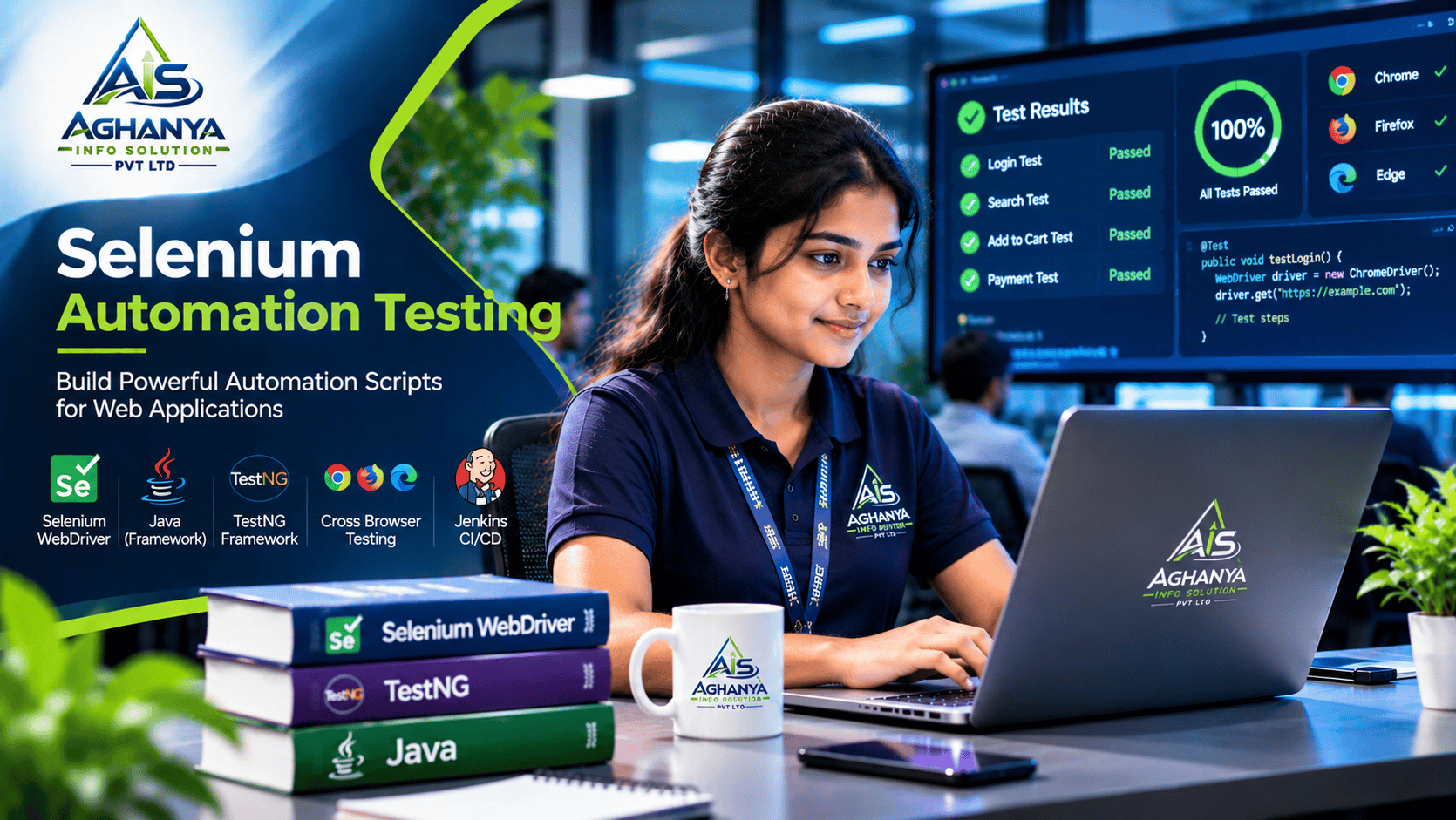
Selenium course illustration: a learner working on Selenium

The technology

What is Selenium?

Selenium is an open-source toolset for automating web browsers. Its WebDriver API lets test code open pages, click, type and verify results in Chrome, Firefox, Edge and other browsers, using languages such as Java and Python.

Why it matters

Teams release software often and cannot re-test every feature by hand. Automated browser tests catch regressions early, and Selenium paired with sound framework design is a core skill for QA automation roles.

What you'll study

Inside the Selenium course

Selenium is the most widely adopted tool for automating web browsers in software testing. This course teaches automation from first principles through to framework design.

You learn the testing fundamentals automation builds on, Java for testers, Selenium WebDriver, TestNG, the Page Object Model and integrating tests into build pipelines.

Learning objectives

The skills you may develop. By the end of the course you should be able to:

  • Understand testing fundamentals and where automation fits
  • Write Java code for automation
  • Automate browser interactions with Selenium WebDriver
  • Organise and run tests with TestNG
  • Design maintainable frameworks with the Page Object Model
  • Run suites through Maven and Jenkins

Course modules

Selenium syllabus outline

7 modules, each building on the last — from fundamentals to applied practice.

  1. Module 1: Testing foundations

    Understand where testing fits in software delivery and how to design tests.

    • SDLC and STLC
    • Test design techniques
    • Manual vs automated testing
  2. Module 2: Java for testers

    Learn the Java you need to write automated tests.

    • Core syntax
    • OOP essentials
    • Collections
  3. Module 3: Selenium WebDriver

    Control a web browser from code: find elements, click, type and wait.

    • Locators and XPath
    • Browser actions
    • Waits and synchronisation
  4. Module 4: Advanced interactions

    Automate harder interactions such as pop-ups, frames and drag-and-drop.

    • Frames, windows and alerts
    • Actions class
    • Screenshots
  5. Module 5: TestNG

    Organise, run and check tests with the TestNG framework.

    • Annotations
    • Assertions
    • Data providers and parallel runs
  6. Module 6: Framework design

    Build a maintainable framework that a team can extend.

    • Page Object Model
    • Data-driven testing
    • Reporting
  7. Module 7: CI integration

    Run tests automatically whenever code changes, using Jenkins.

    • Maven
    • Git
    • Jenkins pipelines

Tools & technologies

  • Selenium WebDriver
  • Java
  • TestNG
  • Maven
  • Jenkins
  • Git

Who should consider it

  • Manual testers moving into automation
  • Graduates targeting QA automation roles
  • Developers responsible for test coverage

Before you start

An understanding of software testing basics is helpful. Java is taught within the course.

Batch timings and fees are shared directly by our team on enquiry.

Let's Find the Right Course for You

Tell us what you want to learn and where you are starting from. Our team will help you choose the right course and share the relevant details.

Prefer a call? Request a callback

By sending, you agree to be contacted about this request.

Keep exploring

  • Software Testing

    QTP / UFT

    Learn functional test automation with UFT One — formerly QuickTest Professional — used by many enterprises to automate regression testing of business applications.

    Key learning areas

    • Automation basics
    • Recording and objects
    • VBScript

    Suits: Manual testers adding automation skills

  • Software Testing

    LoadRunner

    Learn how to measure an application's behaviour under real-world load — and to explain where and why it slows down — using LoadRunner.

    Key learning areas

    • Performance testing concepts
    • VuGen scripting
    • Script enhancement

    Suits: Testers specialising in performance